arrow.industries438

The ultimate guide for Choosing the Right Hinge Size.

Hinge Size Guide: Find the Best Fit for Your Door

The seemingly simple hinge plays a pivotal role in the functionality, security, and longevity of any door. Beyond merely allowing a door to swing open and closed, hinges bear the entire weight of the door, facilitate smooth operation, and contribute to the overall security of a building. Selecting the incorrect hinge size can lead to a host of problems, including sagging doors that drag or fail to close properly, difficulty in opening and closing, undue stress on the door frame, and even structural damage over time. This guide aims to provide a comprehensive understanding of how to choose the appropriate hinge sizes for various types of doors in both residential and commercial settings, ensuring optimal performance and durability.   A Comprehensive Look at Door Types Understanding the different types of doors commonly found in residential and commercial buildings is the first crucial step in selecting the right hinges. Doors vary significantly in their construction, weight, thickness, and intended use, all of which impact the type and size of hinges required. Residential Doors Residential buildings typically feature a variety of door types, each serving a specific purpose. Commercial Doors Commercial buildings have different demands for doors, often requiring enhanced durability, security, and compliance with safety regulations. Other Commercial Door Types: Various other door types are found in commercial settings, including automatic doors, which often utilize integrated mechanisms rather than traditional hinges ; rolling doors and overhead doors, commonly used in warehouses and loading bays, which roll up or slide overhead ; and aluminum doors, often paired with safety glass in smaller commercial buildings, which require ongoing maintenance to prevent hinge corrosion. The hinge requirements for these specialized door types can vary significantly. Commercial doors often have a standard height of 84 inches (7 ft).   Understanding Standard Hinge Sizes and Their Capabilities Hinges are available in a range of standard sizes, typically measured by their height and width when fully opened. For residential applications, common hinge heights include 3 inches, 3.5 inches, and 4 inches , while commercial doors often utilize larger hinges, such as 4.5 inches by 4.5 inches and beyond. The size is usually specified as height by width (e.g., 3.5″ x 3.5″).   A critical factor in hinge selection is the load-bearing capacity, which refers to the maximum weight a single hinge can support while still functioning correctly. This capacity is influenced by the hinge’s dimensions, the material from which it is constructed (e.g., steel, brass, stainless steel), and the quality of its construction. Generally, taller hinges are capable of supporting greater weights compared to shorter ones. For standard doors, using three hinges helps to distribute the weight of the door more evenly across the frame, reducing the stress on individual hinges and prolonging their lifespan. While some sources might suggest specific width and thickness dimensions along with load capacities for standard hinges , the industry generally focuses on the height of the hinge as the primary indicator of size for most applications. Understanding these standard sizes and their inherent load-bearing capabilities is essential for choosing the right hinges for different door types and weights.   Matching Hinges to Doors: Size Recommendations by Type Selecting the appropriate hinge size for each door type is crucial for ensuring proper function and longevity. Interior Doors For standard interior doors with a thickness of 1 3/8 inches (approximately 35 mm) and a width of up to 32 inches (2.67 ft), 3.5-inch hinges are generally sufficient. If the interior door is wider (between 32 inches (2.67 ft) and 36 inches (3 ft)) or heavier, it is advisable to use 4-inch hinges. For heavier solid wood interior doors, 4-inch hinges or even larger sizes might be necessary to provide adequate support. The number of hinges required typically depends on the door’s height and weight, with two or three hinges being common for standard interior doors. A general guideline suggests using one hinge for every 30 inches of door height.   Exterior Doors Exterior doors, which are typically thicker at 1 3/4 inches (approximately 44 mm), often require larger hinges. For standard exterior doors up to 36 inches (3 feet) wide, 4.5-inch hinges are frequently recommended , although some sources indicate that 4-inch hinges are typical. It is prudent to consult the door manufacturer’s recommendations for the most accurate sizing. Wider or heavier exterior doors may necessitate the use of 5-inch or even 6-inch hinges. To enhance stability, three hinges are commonly used for exterior doors. For heavier exterior doors, considering ball-bearing hinges can ensure smoother operation. Additionally, the material of the hinge, such as stainless steel, is important for exterior doors to provide resistance against corrosion from weather exposure.   Fire-Rated Doors Hinge selection for fire-rated doors is governed by stringent safety regulations. Standard fire door hinge sizes often include dimensions around 102mm in height and 76mm or 67mm in width for doors with a thickness of approximately 44mm. Another recommendation suggests optimum dimensions of 100mm high, 30-35mm wide, and 3mm thick, emphasizing the importance of certification to standards like EN1935 and CE marking. According to NFPA 80, the required hinge size and thickness depend on the door’s fire rating, width, and height. For instance, a 1 3/4-inch (approximately 44 mm) thick fire door with a rating of up to 3 hours might require a steel hinge that is at least 4 1/2 inches high and 0.134 inches thick for doors up to 4 feet wide and 8 feet high. A minimum of three fire-rated hinges is typically mandated for standard-sized fire doors , and ball-bearing hinges are commonly used to ensure smooth operation under the weight of these often heavy doors.   Screen Doors Screen doors, being lightweight, often utilize smaller hinges. Sizes around 3 inches in height and 2.5 inches in width might be suitable for lightweight wood screen doors. Spring-loaded hinges are frequently used to provide the convenience of self-closing functionality. Most screen door installations require at least three hinges to provide adequate support for these often frequently used

Hinge Size Guide: Find the Best Fit for Your Door Read More »

kacher hinges - How Many Hinges Do You Need?

The Ultimate Guide to Door Hinges: How Many Do You Need?

Hinges are the essential components that allow doors to function correctly, enabling smooth opening and closing. Using the incorrect number of hinges can lead to problems like sagging or sticking doors. This guide will focus specifically on how to determine the right number of hinges for your door.   How Many Hinges Does Your Door Need? A general guideline suggests using one hinge for every 30 inches of door height, or any fraction thereof. However, several factors can influence this.   Factors That Influence Hinge Quantity Door Height: The height of the door is the primary factor. Doors up to 5 feet tall generally need two hinges. Doors between 5 and 7.5 feet usually require three hinges. For doors from 7.5 to 10 feet, four hinges are commonly recommended. For doors taller than 10 feet, add one hinge for each additional 2.5 feet or fraction thereof.   Door Weight and Material: Heavier doors, like those made of solid core wood, metal, or glass, exert more stress on hinges and often require additional support. Exterior doors also typically benefit from at least three hinges due to their increased weight and potential exposure to the elements. For doors exceeding approximately 90 kg (200 pounds), it’s generally recommended to use four or more stronger, heavy-duty hinges. Doors weighing between approximately 40 kg to 80 kg (88 lbs to 176 lbs) often require three hinges.   Door Width: Wider doors, especially those exceeding 36 or 37 inches, may need an extra hinge for better support and to prevent warping or sagging. Doors wider than 48 inches might also need additional hinges.   Frequency of Use: Doors in high-traffic areas might benefit from more robust hinges and potentially a greater number of them to withstand increased wear.   Recommended Number of Hinges Based on Door Height, Weight, and Width The following table provides a general guideline for the number of hinges recommended based on door height, approximate weight, and width. Keep in mind that these are general recommendations, and specific situations might require adjustments. Doors wider than 36 inches often benefit from an additional hinge.   For doors significantly heavier than average for their height, or wider than 36 inches, consider adding an extra hinge for increased stability and longevity. For doors exceeding approximately 90 kg, it is generally recommended to use at least four heavy-duty hinges.   Hinge Placement While the number of hinges is important, their placement also matters. Generally, the top hinge should be placed about 5 inches from the top of the door, and the bottom hinge around 10 inches from the bottom. If using a third hinge, it should be placed evenly between the top and bottom hinges. For taller doors requiring four hinges, space them evenly.   Conclusion: Ensuring Proper Support Choosing the correct number of hinges is vital for the smooth operation and longevity of your doors. By considering the door’s height, weight, and width, you can ensure adequate support and prevent issues like sagging and sticking. When in doubt, it’s often better to err on the side of using an extra hinge, especially for heavier or wider doors.   Read also : A Comprehensive Guide to Hinge Finishes Follow us on youtube : Arrow Industries

The Ultimate Guide to Door Hinges: How Many Do You Need? Read More »

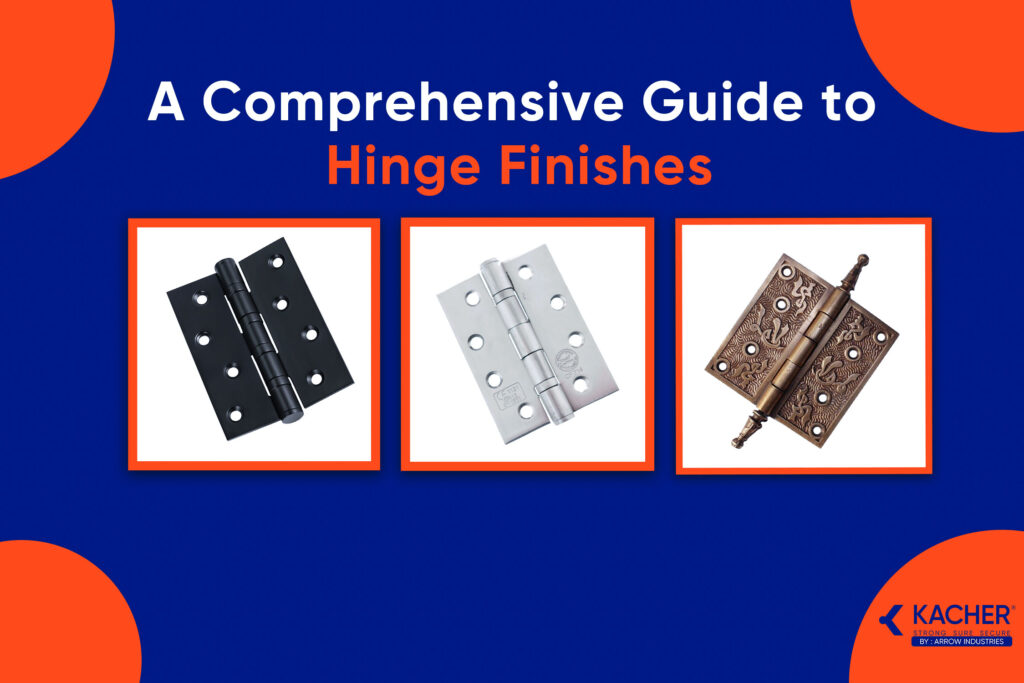
A Comprehensive Guide to Hinge Finishes

A Comprehensive Guide to Hinge Finishes

The finish of a hinge is a critical element that often goes unappreciated. While the primary role of a hinge is undoubtedly to ensure smooth operation, the finish applied to it is integral to the overall aesthetic of your project and plays a significant role in the hinge’s long-term performance and lifespan. The array of hinge finishes available today can be overwhelming, but with the right information, you can make a choice that perfectly complements your design and provides lasting durability. This guide aims to educate you on the common finishes used for hinges, helping you understand their properties, benefits, and applications.   We offer a diverse spectrum of hinge finishes to meet the varied needs and preferences of our customers. Our selection includes the warm and inviting tones of brass and bronze, the sleek modernity of nickel and chrome, the robust practicality of stainless steel, and the customizable versatility of powder coating. Beyond these, we also provide other functional finishes like zinc plating. Each of these categories encompasses various sub-finishes, allowing for a nuanced selection that aligns perfectly with your project’s requirements. Quick Overview This blog post will delve into the world of hinge finishes, covering popular options like brass, bronze, nickel, chrome, stainless steel, and powder coating. For each finish, we will explore its properties, aesthetic appeal, durability, corrosion resistance, typical applications, benefits, and potential drawbacks. Additionally, we will discuss how different finishes impact a hinge’s functionality and lifespan, provide guidance on matching hinge finishes with various architectural styles, and highlight emerging trends in hinge finishes to help you make an informed decision for your project. Deep Dive into Popular Hinge Finishes: Unveiling Properties, Benefits, and Drawbacks A. The Timeless Elegance of Brass Finishes Brass finishes have long been celebrated for their classic and elegant appeal, making them a favored choice in traditional and vintage interior design styles. The inherent warmth of brass lends a touch of sophistication to any door or cabinet. Within the realm of brass finishes, several distinct sub-categories offer unique aesthetic qualities.   The general properties of brass finishes include good durability , moderate corrosion resistance , and a warm, classic aesthetic appeal. Notably, brass also possesses natural antimicrobial properties. Typical applications for brass hinges span traditional interiors, historical renovations, and situations where decorative accents are paramount. While the timeless look and potential for adding warmth and elegance are significant benefits, the susceptibility to tarnishing, the need for regular maintenance, and a potentially higher cost are drawbacks to consider. The different sub-categories within brass finishes allow customers to select a level of sheen and a specific shade that best aligns with their vision for a traditional space.   B. The Rich Character of Bronze Hinge Finishes Bronze finishes are known for their deep, warm tones that exude a sense of character and are often chosen for traditional, rustic, and antique design styles. Bronze is recognized for its durability and aesthetic richness.   Bronze finishes generally offer very high durability and excellent corrosion resistance. Their aesthetic appeal is often described as vintage, rustic, and elegant. Typical applications include antique restorations, traditional and farmhouse-style homes, as well as exterior applications where a weathered or aged look is desired. A key benefit of bronze is its longevity and high resistance to corrosion, with oil-rubbed bronze developing a unique patina that many appreciate. However, bronze hinges can be more expensive, and the evolving patina of oil-rubbed bronze might not be suitable for customers seeking a consistently uniform finish. The choice between these bronze sub-finishes often depends on the desired level of aging and the need for enhanced protection.   C. The Modern Versatility of Nickel Hinge Finishes Nickel finishes have gained significant popularity for their modern versatility, fitting seamlessly into contemporary and transitional interior design schemes. Their neutral tones and subtle sheen make them a widely adaptable option.   Nickel finishes generally exhibit good durability and corrosion resistance. Their aesthetic is often perceived as modern, subtle, and elegant. Typical applications include contemporary kitchens and bathrooms, as well as modern and transitional interiors. A key benefit of satin and brushed nickel is their versatility and ease of cleaning, with brushed nickel being particularly good at hiding fingerprints. One potential drawback is that nickel finishes can sometimes be slightly more expensive than other plated options. The range of nickel sub-finishes allows customers to select a level of sheen that best suits their design vision, from the soft subtlety of satin nickel to the more pronounced reflectivity of polished nickel.   D. The Sleek and Durable Appeal of Chrome Finishes Chrome finishes are widely recognized for their bright and modern aesthetic, making them a popular choice in contemporary and minimalist design styles. Chrome is known for its durability and clean look.   Chrome finishes exhibit very high durability and excellent corrosion resistance. Their aesthetic is typically described as shiny, modern, and clean, with satin chrome offering a more subdued look. Typical applications include modern bathrooms and kitchens, minimalist and industrial designs, as well as commercial facilities where durability is paramount. While polished chrome offers a bright and clean look with exceptional durability and corrosion resistance, it can show fingerprints and water spots more readily. Satin chrome, on the other hand, provides a contemporary feel with good durability and less visibility of smudges.   E. The Robustness of Stainless Steel Stainless steel is renowned for its exceptional durability and inherent resistance to corrosion, making it an ideal material for hinges, particularly in environments where exposure to moisture or harsh conditions is a concern. Its inherent properties make it suitable for a wide range of applications.   Stainless steel boasts excellent durability and corrosion resistance , making it particularly well-suited for outdoor use, areas with high moisture levels like bathrooms and kitchens, industrial settings, and modern interiors. While its exceptional durability and corrosion resistance are significant advantages , stainless steel hinges can be more expensive, and their industrial aesthetic might not align with all decorative preferences. Different grades of stainless steel, such

A Comprehensive Guide to Hinge Finishes Read More »

The Ultimate Guide to Hinge Materials

The Ultimate Guide to Hinge Materials

One of the most crucial decisions when selecting hinges is choosing the right material. While metal is the dominant material, the specific type of metal significantly impacts performance, durability, and longevity. This guide provides a comprehensive breakdown of five common hinge materials, helping you make informed choices for any application. Hinges: they’re more than just metal. They’re the silent backbone of countless applications. But choosing the right metal is critical. This guide breaks down the five key hinge materials, empowering you to make informed decisions that ensure durability and longevity. Before diving deep into the specifics, here’s a side-by-side comparison of the five most commonly used hinge materials. This table highlights their descriptions, advantages, disadvantages, and typical applications—giving you a quick overview to help guide your selection process. Use this table as a reference point while exploring the detailed insights below. Hinge Material Comparison Table Material Description Advantages Disadvantages Common Applications Cold-Rolled Steel Iron alloy formed at room temp, enhancing strength and surface finish. – High strength & durability- Cost-effective – Prone to rust without coating- Less corrosion-resistant Interior doors, furniture, general hardware Stainless Steel Iron alloy with carbon; naturally forms a rust-resistant protective layer. – Excellent rust resistance- Long-lasting- Low maintenance – Higher cost- Difficult to machine Outdoor gates, marine use, kitchens, hospitals Aluminum Lightweight pure metal with natural corrosion resistance – Lightweight- Corrosion-resistant- Low-cost – Lower strength- Galvanic corrosion with other metals Aircraft parts, lightweight doors/windows Brass Alloy of copper and zinc; highly malleable and visually appealing – Aesthetic appeal- Easy to shape- Corrosion-resistant – Soft and crack-prone- Expensive Decorative items, antique furniture, low-stress hardware Bronze Copper and tin alloy offering strength and excellent friction resistance – Durable- High ductility- Rust resistant- Low friction – More costly than brass- Heavier than aluminum Marine hardware, bearings, architectural applications This comparison table offers a quick reference to the strengths and limitations of each hinge material. Whether your priority is durability, appearance, weight, or corrosion resistance, understanding these key factors will help you choose the material that best fits your specific needs. Now, let’s take a closer look at each hinge material in detail. 1. Cold-Rolled Steel: Strength and Durability 2. Stainless Steel: Corrosion Resistance and Longevity 3. Aluminum: Lightweight and Corrosion-Resistant 4. Brass: Malleability and Aesthetic Appeal 5. Bronze: Strength and Friction Resistance Choosing the Right Material: When selecting hinges, consider the following factors: Conclusion: Understanding the properties of different hinge materials is essential for choosing the right hinges for your needs. By considering factors such as strength, corrosion resistance, and cost, you can ensure optimal performance and longevity. Also Read : The Ultimate Butt Hinges Guide: Types, Uses & Benefits Also Follow us on Facebook : facebook.com/Kacher22 & Youtube : youtube.com/@arrowindustries438Post navigation

The Ultimate Guide to Hinge Materials Read More »

TYPES OF BUTT HINGES

The Ultimate Butt Hinges Guide: Types, Uses & Benefits

Hinges may seem like a small part of your door, but they are the unsung heroes of smooth movement and durability. Among the many types, butt hinges stand out as one of the most commonly used for doors, cabinets, and furniture. Choosing the right butt hinge isn’t just about picking a piece of hardware—it’s about ensuring longevity, functionality, and aesthetics. With over 8 years of expertise in hinge manufacturing, we at Kacher have mastered the craft of producing high-quality, durable hinges that stand the test of time. In this blog, we’ll explore the various types of butt hinges, their features, and where they are best used. 👉 Now scroll down for the detailed explanations, installation tips, and expert advice on selecting the right hinge for your needs! 1.Ball Bearing SS Butt Hinges If you want a hinge that operates silently and smoothly, ball-bearing stainless steel butt hinges are the way to go. These hinges are reinforced with ball bearings, reducing friction and extending the hinge’s life. Key Features: ✅ Ideal for heavy doors (used in commercial and residential settings)✅ Rust and corrosion-resistant (Perfect for coastal areas)✅ No squeaking noise (Smooth operation)✅ Long lifespan with minimal maintenance Best Used For:✔️ Main entrance doors✔️ Fire-rated doors✔️ Office and commercial buildings 2. Pin-Type Butt Hinges Need a hinge that allows for quick door removal without hassle? Pin-type butt hinges have a removable or fixed pin, allowing easy door installation and removal. Key Features:✅ Easy to detach the door when needed✅ Strong and reliable for interior doors✅ Available in various materials like brass, steel, and stainless steel Best Used For:✔️ Bedroom and bathroom doors✔️ Removable partitions✔️ Traditional wooden doors 3. Concealed/Welded Butt Hinges Want a hinge that blends seamlessly into the door frame for a sleek look? Concealed butt hinges are designed to remain hidden when the door is closed, offering a seamless, elegant look. Welded butt hinges, on the other hand, are permanently attached for maximum strength. Key Features:✅ Hidden design for sleek aesthetics✅ No visible screws or bolts✅ Welded variants offer extreme durability Best Used For:✔️ Modern luxury doors✔️ Metal gates and industrial doors✔️ High-security doors 4. L-Hinges For doors that need additional corner support and flexibility, L-hinges are the perfect choice! These hinges are uniquely shaped like the letter “L” and are widely used for corner-mounted doors and cabinets. Key Features:✅ Provides extra support for corner doors✅ Available in decorative and industrial designs✅ Easy to install and highly durable Best Used For:✔️ Cabinet doors✔️ Small gates and furniture✔️ Industrial machinery 5. Z-Hinges If you love the rustic charm of barn doors, Z-hinges are a must-have! These hinges, shaped like the letter “Z,” are mainly used for barn doors and gates. Key Features:✅ Designed for heavy-duty applications✅ Rust-resistant (great for outdoor use)✅ Offers a traditional, vintage look Best Used For:✔️ Barn doors and farm gates✔️ Storage sheds✔️ Antique-style doors 6. Butterfly Hinges Give your furniture and doors an artistic touch with butterfly hinges! These decorative hinges resemble a butterfly when fully opened and are often found in vintage and antique furniture. Key Features:✅ Aesthetic and decorative appeal✅ Available in brass, bronze, and steel finishes✅ Easy to install Best Used For:✔️ Home Interiors: For doors, cabinets, and furniture pieces.✔️ Commercial Spaces: In offices, retail stores, and other professional locations.✔️Decorative Furniture: To enhance the attractiveness of antique or modern furniture. 7. Spring Hinges (Self-Closing Hinges) Looking for a hands-free door-closing solution? Spring hinges come with an internal spring mechanism that automatically closes the door after opening. Key Features:✅ Self-closing mechanism for safety✅ Great for security doors✅ Reduces unnecessary door slamming Best Used For:✔️ Residential: Spring hinges are popular for doors leading into garages, ensuring they close automatically. ✔️ Commercial: They are used in high-traffic areas like hospitals, restaurants, and offices, where doors need to swing freely in both directions and close automatically. ✔️ Fire Doors: Spring hinges are used in fire doors to ensure automatic closure in case of a fire.  8. W-Hinges (Wide Throw Hinges) Want a hinge that lets doors swing open past 90 degrees without any obstruction? W-Hinges have a greater width than height, allowing doors to open widely while maintaining durability. Key Features:✅ Allows full range of motion for doors✅ Ideal for thick door frames✅ Durable construction for long-term use Best Used For:✔️ Kitchen Cabinets✔️ Furniture Doors✔️ Above-Head Cabinets Choosing the Right Butt Hinge: Key Considerations When selecting a butt hinge, consider the following factors: ✔️ Weight Capacity: Ensure the hinge can support your door’s weight. Heavy-duty applications require ball-bearing or welded hinges. ✔️ Material: Stainless steel for rust resistance, brass for elegance, and steel for strength. ✔️ Security Needs: If security is a priority, opt for welded or pin-type hinges with security features. ✔️ Frequency of Use: High-traffic doors require ball-bearing hinges for smooth and long-lasting performance. ✔️ Aesthetic Appeal: Decorative options like butterfly hinges add beauty to furniture and doors. The right butt hinge can make all the difference in your door’s functionality and durability. Whether you need a heavy-duty hinge for an industrial door or a decorative hinge for furniture, choosing the right type is essential.👉 Need expert advice on choosing the right hinge? Contact Kacher today for professional recommendations and high-quality hinge solution. Also Follow us on Facebook : facebook.com/Kacher22 & Youtube : youtube.com/@arrowindustries438

The Ultimate Butt Hinges Guide: Types, Uses & Benefits Read More »

Scroll to Top