

The seemingly simple hinge plays a pivotal role in the functionality, security, and longevity of any door. Beyond merely allowing a door to swing open and closed, hinges bear the entire weight of the door, facilitate smooth operation, and contribute to the overall security of a building. Selecting the incorrect hinge size can lead to a host of problems, including sagging doors that drag or fail to close properly, difficulty in opening and closing, undue stress on the door frame, and even structural damage over time. This guide aims to provide a comprehensive understanding of how to choose the appropriate hinge sizes for various types of doors in both residential and commercial settings, ensuring optimal performance and durability.
A Comprehensive Look at Door Types
Understanding the different types of doors commonly found in residential and commercial buildings is the first crucial step in selecting the right hinges. Doors vary significantly in their construction, weight, thickness, and intended use, all of which impact the type and size of hinges required.
Residential Doors
Residential buildings typically feature a variety of door types, each serving a specific purpose.
- Interior Doors: These doors are used within the home to separate rooms and spaces. Common examples include bedroom doors, bathroom doors, closet doors, pantry doors, and hallway doors. Generally, interior doors are lighter in weight compared to exterior doors and have a standard thickness, often around 1 3/8 inches (approximately 35 mm). Standard interior doors typically measure 80 inches (6.67 ft) in height. The frequency of use can vary depending on the location, but it is generally moderate. Interior doors are constructed from various materials, including hollow core, which features a thin outer layer with a cardboard or plastic inner core making them significantly cheaper and lighter ; solid core, which offers more strength and better sound insulation ; panel doors, characterized by one or more panels set within a frame and available in various materials like wood, fiberglass, or composite ; and flush doors, known for their simple, clean design with a flat surface, often made with a solid or hollow core and customizable with paint or veneer. The construction and weight differences between these types necessitate careful consideration when choosing hinge sizes. For instance, a solid core door will require more robust hinges than a hollow core door of the same dimensions.
- Exterior Doors: These doors serve as entry and exit points to the home, including front doors, back doors, and doors leading to patios or decks. Exterior doors are typically heavier and thicker, often ranging from 1 3/4 inches to 2 inches (approximately 44 mm to 51 mm) , as they are usually constructed from solid wood or metal to provide security and insulation against weather elements. Standard exterior doors usually have a height of 80 inches (6.67 ft), but sometimes they are taller, reaching 84 inches (7 ft) or 96 inches (8 ft). Due to their weight and exposure to external forces, exterior doors require more robust hinges to ensure security and long-term durability. French doors, which are hinged doors with glass panels, and double doors, consisting of two hinged doors in one opening, are also common exterior options that may require specific hinge considerations due to their increased weight and size.
- Screen Doors: These are lightweight doors primarily designed for ventilation and to keep insects out. They are commonly made from materials like wood, aluminum, or fiberglass, often featuring glass panels that can be swapped for screens. The hinges for screen doors need to be functional and appropriate for their light weight. Spring hinges are often used to provide a self-closing functionality, which is a common requirement for screen doors.
Commercial Doors
Commercial buildings have different demands for doors, often requiring enhanced durability, security, and compliance with safety regulations.
- Hollow Metal Doors: These are the most common type of door found in commercial construction projects due to their durability and fire resistance. Constructed with steel frames, hollow metal doors are robust and often equipped with secure mortise locks and strong hinges. Stainless steel options are available for enhanced durability and resistance to corrosion. Given their frequent use in commercial settings and their robust construction, hollow metal doors necessitate hinges that can withstand heavy traffic and support their weight.
- Wood Doors (Commercial Grade): While hollow metal doors are prevalent, commercial-grade wood doors are utilized in high-end establishments such as hotels, luxury offices, and apartment complexes for their aesthetic appeal. These doors can be made from solid wood or feature thin wood veneer sheets wrapped over tougher core materials like solid timber or pressed materials. Fire-resistant commercial wood doors are also available. The hinges for these doors must be capable of supporting their weight while maintaining the aesthetic integrity of the installation.
- Glass Doors: Transparency and a sleek aesthetic are often desired in commercial spaces like retail stores, office buildings, banks, and shopping malls, making glass doors a popular choice. These doors can be full glass or feature glass panels within aluminum or other frames. While visually appealing, glass doors can be heavy, requiring specialized hinges to support their weight and ensure smooth operation. Security can also be a concern with glass doors, potentially influencing the choice of hinges and the need for additional security measures.
- Fire-Rated Doors: These doors are critical for safety in both residential and commercial buildings, designed to withstand fire for a specified duration, such as 30 minutes (FD30) or 60 minutes (FD60). Fire-rated doors have specific requirements for all their components, including hinges, which must also be fire-rated. Building codes and standards, such as EN1935 and CE marking , as well as NFPA 80 , dictate the necessary hinge size, material (typically steel or stainless steel ), and fire rating. These doors are often heavier due to their fire-resistant construction and typically require a minimum of three hinges. Ball-bearing hinges are commonly used on fire-rated doors due to their durability and smooth operation.
Other Commercial Door Types: Various other door types are found in commercial settings, including automatic doors, which often utilize integrated mechanisms rather than traditional hinges ; rolling doors and overhead doors, commonly used in warehouses and loading bays, which roll up or slide overhead ; and aluminum doors, often paired with safety glass in smaller commercial buildings, which require ongoing maintenance to prevent hinge corrosion. The hinge requirements for these specialized door types can vary significantly. Commercial doors often have a standard height of 84 inches (7 ft).
Understanding Standard Hinge Sizes and Their Capabilities
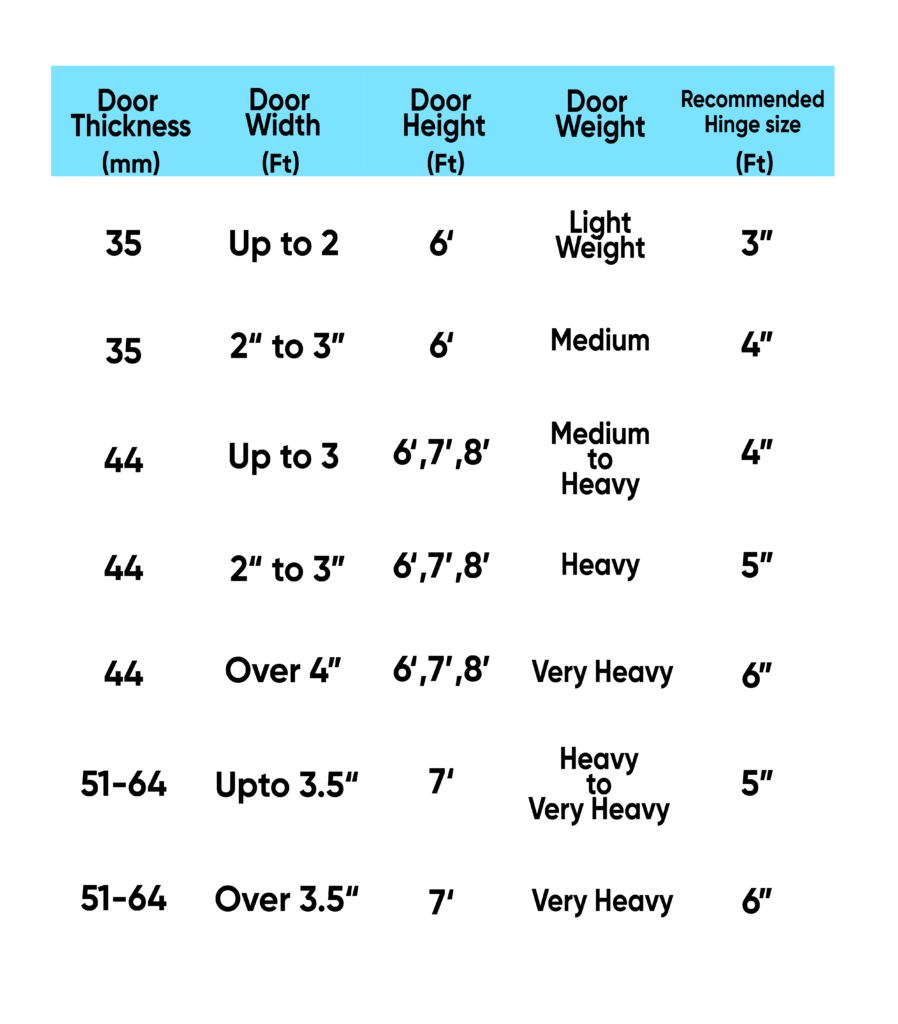
Hinges are available in a range of standard sizes, typically measured by their height and width when fully opened. For residential applications, common hinge heights include 3 inches, 3.5 inches, and 4 inches , while commercial doors often utilize larger hinges, such as 4.5 inches by 4.5 inches and beyond. The size is usually specified as height by width (e.g., 3.5″ x 3.5″).
A critical factor in hinge selection is the load-bearing capacity, which refers to the maximum weight a single hinge can support while still functioning correctly. This capacity is influenced by the hinge’s dimensions, the material from which it is constructed (e.g., steel, brass, stainless steel), and the quality of its construction. Generally, taller hinges are capable of supporting greater weights compared to shorter ones. For standard doors, using three hinges helps to distribute the weight of the door more evenly across the frame, reducing the stress on individual hinges and prolonging their lifespan. While some sources might suggest specific width and thickness dimensions along with load capacities for standard hinges , the industry generally focuses on the height of the hinge as the primary indicator of size for most applications. Understanding these standard sizes and their inherent load-bearing capabilities is essential for choosing the right hinges for different door types and weights.
Matching Hinges to Doors: Size Recommendations by Type
Selecting the appropriate hinge size for each door type is crucial for ensuring proper function and longevity.
Interior Doors
For standard interior doors with a thickness of 1 3/8 inches (approximately 35 mm) and a width of up to 32 inches (2.67 ft), 3.5-inch hinges are generally sufficient. If the interior door is wider (between 32 inches (2.67 ft) and 36 inches (3 ft)) or heavier, it is advisable to use 4-inch hinges. For heavier solid wood interior doors, 4-inch hinges or even larger sizes might be necessary to provide adequate support. The number of hinges required typically depends on the door’s height and weight, with two or three hinges being common for standard interior doors. A general guideline suggests using one hinge for every 30 inches of door height.
Exterior Doors
Exterior doors, which are typically thicker at 1 3/4 inches (approximately 44 mm), often require larger hinges. For standard exterior doors up to 36 inches (3 feet) wide, 4.5-inch hinges are frequently recommended , although some sources indicate that 4-inch hinges are typical. It is prudent to consult the door manufacturer’s recommendations for the most accurate sizing. Wider or heavier exterior doors may necessitate the use of 5-inch or even 6-inch hinges. To enhance stability, three hinges are commonly used for exterior doors. For heavier exterior doors, considering ball-bearing hinges can ensure smoother operation. Additionally, the material of the hinge, such as stainless steel, is important for exterior doors to provide resistance against corrosion from weather exposure.
Fire-Rated Doors
Hinge selection for fire-rated doors is governed by stringent safety regulations. Standard fire door hinge sizes often include dimensions around 102mm in height and 76mm or 67mm in width for doors with a thickness of approximately 44mm. Another recommendation suggests optimum dimensions of 100mm high, 30-35mm wide, and 3mm thick, emphasizing the importance of certification to standards like EN1935 and CE marking. According to NFPA 80, the required hinge size and thickness depend on the door’s fire rating, width, and height. For instance, a 1 3/4-inch (approximately 44 mm) thick fire door with a rating of up to 3 hours might require a steel hinge that is at least 4 1/2 inches high and 0.134 inches thick for doors up to 4 feet wide and 8 feet high. A minimum of three fire-rated hinges is typically mandated for standard-sized fire doors , and ball-bearing hinges are commonly used to ensure smooth operation under the weight of these often heavy doors.
Screen Doors
Screen doors, being lightweight, often utilize smaller hinges. Sizes around 3 inches in height and 2.5 inches in width might be suitable for lightweight wood screen doors. Spring-loaded hinges are frequently used to provide the convenience of self-closing functionality. Most screen door installations require at least three hinges to provide adequate support for these often frequently used doors. Butt hinges are a common choice for screen doors, offering a durable and classic appearance.
Beyond the Basics: Other Factors Influencing Hinge Size
While door type is a primary consideration, other factors also play a significant role in determining the appropriate hinge size.
Door and Frame Materials
The materials of both the door and the frame exert a considerable influence on the weight that the hinges must support. Heavier materials, such as solid hardwood or metal, will necessitate the use of larger and stronger hinges compared to lighter doors made of hollow core or fiberglass. Additionally, the frame material must possess sufficient strength to adequately support the weight of the door and the hinges attached to it. Different door and frame materials may also require specific types of hinges with varying load capacities to ensure a secure and functional installation.
The Impact of Door Closers and Other Hardware
The presence of door closers can significantly increase the stress on door hinges due to the added force and the increased frequency of door operation. It is recommended to account for this additional stress by selecting stronger or larger hinges. For instance, one guideline suggests adding a 20% safety margin to the calculated load per hinge when a door closer is used, and an even larger margin (75%) if the closer has a back-check function. Furthermore, any heavier hardware installed on the door, such as robust security locks or panic bars, will contribute to the overall weight of the door and may necessitate the use of larger hinges to ensure adequate support and prevent sagging.
Conclusion: Ensuring Smooth Operation and Longevity with the Right Hinges
Selecting the correct hinge size for your doors is a critical decision that impacts their functionality, security, and lifespan. By carefully considering the type of door, its weight, the frequency of its use, the materials of the door and frame, and any additional hardware like door closers, you can ensure smooth operation and prevent premature wear or failure. While national standards in India, such as those provided by the BIS, offer valuable guidance on hinge quality and quantity. If there is any uncertainty about the appropriate hinge size for a particular application, it is always best to consult with a qualified hardware professional for expert advice. By taking the time to choose the right hinges, you are investing in the long-term performance and security of your doors.
Also read : The Ultimate Guide to Door Hinges: How Many Do You Need?
Also subscribe our youtube channel : arrowindustries438
Follow us on facebook : Arrow industries